Showing posts with label The Royal Tenenbaums. Show all posts

Tuesday, October 26, 2010

Curio: Wes Anderson's Bad Dads

Alexa from Pop Elegantiarum here with your weekly arts and crafts.

There is a very cool exhibit coming up for those in San Francisco. As I've noted many times, Wes Anderson is a bottomless source of inspiration for visual artists. So Spoke Art, a transient art gallery and publishing house based in the Bay Area, is taking advantage of the bounty by putting on an art show tribute to Wes Anderson titled Bad Dads ("as nearly every Wes Anderson character has family issues, notably father issues"). The exhibit opens this Saturday at LoPo Gallery. And apparently there will be prints available soon from Spoke's online store!

Here's a preview of some of the images. It's not surprising that Royal Tenenbaum (of, well, The Royal Tenenbaums) figures largely.


Lauren Gregg


Dave Greco


Tim Doyle


Max Dalton


Kevin Tong


Caia Koopman

Tuesday, August 17, 2010

Curio: Film and a Felt-Tip

Alexa here with more film arts and crafts. Jessica Mae Hendrickson's doodles may just be proof that it's impossible not to have fun with markers. I came across her etsy shop recently, and even though it seems like an elaborate prank (it's called "Buy My Shit", after all), I may put up some cash for her punny, absurdist, felt-tip magic. While she makes marker art of all kinds, here is a selection of her film-related subjects.

A framed Corky St. Clair.

Track (suit) Galifianakis.

Michael Pitt, and banana, in The Dreamers.

The many faces of John Goodman, as balloons.
(Wish I'd had these for my daughter's birthday party.)

Ari, Chas, and Uzi Tenenbaum.

Tim Roth as a sloth.

Resigned romance in Eternal Sunshine.

Saturday, May 15, 2010

Thursday, January 28, 2010

Modern Maestros: Wes Anderson

Robert here, continuing my series on great contemporary directors. I thought I might as well round-out the Anderson trifecta with Wes Anderson, a director on whom I’ve had mixed feelings (though I cannot deny his influence). So to all those who love, love, love Mr. Anderson, please accept my advance apologies. I shall try to keep this unbiased. If nothing else, Wes Anderson has been the only director to successfully convince Natalie Portman to go sans clothes, and that’s certainly worth celebrating.

Maestro: Wes Anderson
Known For: Quirky, comedic tales of families and failure.
Influences: Satyajit Ray, Orson Welles, Mike Nichols, Quentin Tarantino and perhaps most of all Hal Ashby.
Masterpieces: I find Anderson to be endlessly fascinating, but I’m not in love with any of his films, except for Fantastic Mr. Fox.
Disasters: none (I promise I’ll eventually get to a director with a disaster, I swear)
Better than you remember: The Life Aquatic with Steve Zissou was his most poorly received film and I can’t say I disagree. So no entries here.
Awards: Nominations at the Oscars, BAFTAs, Venice and Berlin. Not a whole lot of substantial wins.
Box Office: The Royal Tenenbaums with over 50 million is the winner.
Favorite Actor: Bill Murray and Owen Wilson tie, each in five of Anderson’s six films.


Wes Anderson was a part of a new generation of indie directors that came to prominence in the late 1990's including (though not limited to) David O. Russell, P.T. Anderson, and Spike Jonze. And though he may not be the most talented among that group, he's possibly the most influential. His is the career that launched a thousand quirky comedies. Without Wes Anderson would there be a Little Miss Sunshine? a Juno? an Eagle vs. Shark? The tragi-comedy about a sad figure set to impossibly trendy music isn't a new concept, but one may just have to credit Anderson for hastening its recent rise (for better or worse). What's so surprising is that even though Anderson is thought of as a "hip" or "trendy" director his themes are not exactly the encapsulation of "cool". Stories of once-great men, their downfalls, and familial relationships aren't as cool as stories about killers or kings.  But it's here where Anderson keeps returning. Royal Tenenbaum, Steve Zissou, Mr. Fox are all men attempting to recapture some past glory (and who all star in films named after themselves). And do they recapture their past glory?  Well that's complicated.  Anderson never gives us a clear ending.  His ulitmate suggestion seems to be that life is neither happy nor sad nor simple, yet almost always ironic. So yes you can find your white whale (or jaguar shark) but when you get there the price you've paid for your goal will diminish its worth.

It was during Roger Ebert and Martin Scorsese's discussion on the best films of the 1990's (Scorsese selected Bottle Rocket to his list) where they noted this sense of existential irony that permeates through that decade's independent cinema. "Everything has quotation marks around it" says Roger Ebert. And there's something about Wes Anderson's style that puts him at the forefront of this phenomenon. Anderson's construction and framing often highlight the artificiality of his films. Realism is farthest from his mind and he regularly betrays convention with the film drawing attention to itself as a result. Anderson would rather shoot a conversation between two characters in its entirety with both in profile then as series of cross-cut over-the-shoulder shots. Why is this? Is it to achieve a sense of unreal? Is it to maintain the tempo of a comedic scene? Is it just to break the rules? A little bit of all three I think.

Once great

It's nice to see Wes Anderson back on top of the world again with his most acclaimed film in eight years. Even though his two prior films achieved interesting things (The Life Aquatic allowed him to work with Herny Selic and The Darjeeling Limited let him homage Indian cinema in a way he'd been hinting at for a while) neither was able to capture the brilliance of The Royal Tenenbaums, which was, at the time, the quintessential Wes Anderson film, hitting all of his most common themes and also having fun taking a somewhat affectionate look at the oppression that comes from being rich and famous (an offshoot of his interest in failed great men and a concept taken right from Hal Ashby). But Fantastic Mr. Fox gave Anderson the chance to try animation, a genre quite possibly perfectly suited to Anderson's constructed ironic sensibilities. What's next for Anderson we don't know. IMDb and Wikipedia each list different future projects, but there's little doubt that he'll have another film out soon and it will continue to influence young directors while clearly setting himself apart from those who try to do what he does with his superior sense of style and craft.

Tuesday, November 17, 2009

Decade in Review: 2001 Top Ten

What follows is my original top ten list of 2001. We'll discuss each year of the decade over the next month or two (we already did 2000). I do this because I am curious about which films "stick" and which fade and why and maybe you are too? Best year of the decade I think. The top five films would all be valid #1 film choices in some years. New comments are in red.

Note: This list references films released in NYC in 2001, not year of production
or year in which they first the hit festival circuit or whatnot.


Runners Up (in descending order): Sexy Beast, Ali, Series 7: The Contenders, The Others, Last Resort and Waking Life. I don't remember loving Ali that much... and more than The Others? I don't remember that at all. I mean Nicole Kidman was the shit TWICE OVER in 2001.

In my round up of the year I also sang the praises of
Monsters, Inc, Crazy/Beautiful and Wet Hot American Summer. Even though I listed Monsters, Inc as "underrated" I still didn't have it in the top 16. That was weird, me! I never consider documentaries eligible for the year's top ten. That's a quirk of mine that I can't really defend except for to say that I don't see enough of them to fairly evaluate their merits and I find it nearly impossible to compare their merits to those of narrative features. That said, in 2001 I was wild for The Gleaners and I.

10 No Man's Land
This acclaimed Bosnian film from Danis Tanovic is a startling visceral comedy about the lunacy of war. Let's hope it beats the overpraised (if admittedly enjoyable) Amélie to the foreign language Oscar this year.

I was surprisingly prophetic there though I understand a lot of people are still mad about that underdog win.

09 The Royal Tenenbaums
A film that flirts with greatness and becomes all the more touching by missing the mark. There's one great scene after another in Wes Anderson's fairy tale document on a family of failed geniuses. The film is blessed with a beautiful team-spirit bouquet of fine performances from Paltrow, Hackman, Huston, Glover, and the Wilson brothers. They've got character.

er... I get what I was saying but I'm not so sure this film missed the mark. It's a thing of melancholy beauty and curious singular humor. Anderson's best by a significant margin.

08 In the Bedroom
Todd Field's studied and terrific debut may not be the masterwork some have claimed it to be but it's a damn good film nonetheless. Its most remarkable feature is its honest deceptiveness. You think it's a love story. Bang, It's not. You think it's a thriller. Oops, think again. It's not that the film is lying, but that we are so accustomed to certain plot trajectories that its difficult to see the film's harrowing turns coming or to immediately understand how thoroughly it undermines traditional notions of revenge or catharsis. Bonus points to the cast for illuminating the emptying effects of grief, and the rage of the broken.

Todd Field and Wes Anderson's subsequent films have made me question my love for these on occasion. I can't say that I remember In the Bedroom well but I like what I remember still. That The Tenenbaums is all the way down at #9 only goes to show what a great year 2001 was.

07 Tillsammans (Together)
The sweetest film of the year is also one of the smartest. Lukas Moodyson throws a broken family into a 70s commune and the resulting emotional, personal, romantic, and idealistic collisions that ensue expose, illuminate, and energize all involved. "Feel good" is a term often used to describe manipulative, simple-minded, happy endings and Hollywood-style sugarcoating. Thankfully, this Swedish comedy has neither of those attributes and actually feels good. It uplifts while engaging you both emotionally and intellectually.

Nobody talks about this movie (maybe because Lukas Moodyson's subsequent films have been so brutal as to be deemed unwatchable by some fans of his first movies) and in truth I don't remember it well but I do remember how I felt leaving the theater: marvelous.

06 Gosford Park
No movie this year approaches it in terms of its nimbleness and fluidity in mixing character, theme and wit. Robert Altman's return to form is wildly entertaining.

05 Mulholland Dr.
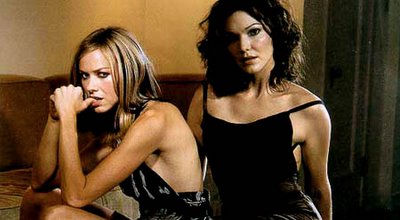
This, the critical darling of 2001 (OK, In the Bedroom came close) was the year's most familiar complete stranger. We've seen all the Lynchian motifs, images, and characters before but this time, the singular auteur fashioned something new and revelatory out of his used parts. This picture, a grand one, had tremendous "give" in it allowing for multiple correct intrepetations, thereby prompting the most fascinating critical discussions of the year. But all that aside, the truly smart way to watch Lynch's mindfuck is to just let go and give in to its undeniable and nonsensical pull. From the frenetic overexposed jitterbug opening sequence to the final silencing moment, it's undeniably gripping. Just dive into the blue box.

Subsequent years have only strengthened its grip on the imagination, haven't they?

04 Hedwig and the Angry Inch
A triple threat triumph from writer/director/star John Cameron Mitchell. That this unforgettable theatrical experience made such a successful transfer to the screen with its punk edge, subversive charm, and visceral rock spirit intact was the year's happiest little miracle.

03 In the Mood for Love
Wong Kar Wai has outdone himself. The year's most glorious foreign film has the year's best cinematography. It paints a masterful and hypnotic meditation on memory, emotional stasis, and romantic yearning. The luminous coupling of Maggie Cheung as Mrs Chan and Tony Leung Chiu Wai as Mr. Chow astonish: They're as erotic as Mulholland Dr's Nancy Drew lovers without a sex scene, as glamorous as Moulin Rouge!'s doomed bohemians without as many costume changes and in the end they're more emotionally affecting than either of those sensational couplings. Unmissable.

If I had a gazillion dollars I would have this movie projected on my bedroom wall 24/7. Who needs photos, wallpaper, art or paint? Just these visuals on loop, forever.

02 The Lord of the Rings: The Fellowship of the Ring
Pure magic. Peter Jackson's new film sets the bar high. Released just one month prior to it, Harry Potter looks even more factory-like next to it. The Fellowship of the Ring recalls the grandiose Star Wars magic minus the bad acting and none of the eventual dissappointments of an embarassing Episode One. Fellowship is compared to many films but the one it looks prettiest sitting next to is Crouching Tiger Hidden Dragon. In just two short years, two signature adventure epics for The East and the West have arrived that dwarf everything their genre has offered for years. Both films will likely inspire future filmmakers who are now but starry eyed children discovering the enormous magic of the cinema while watching them for the first time.

01 Moulin Rouge!
It's no secret that I've always adored Bazmark productions. (Strictly Ballroom and Romeo + Juliet were also top ten entries in their years.) But Luhrmann and his troupe topped themselves this time. With the final film in his Red Curtain Trilogy celebrating 'real artificiality,' Baz delivered his masterpiece. A lot of ink has been spilt covering Bazmark's divisive musical fantasia and I could certainly spill a lot more, but I think this revolution of a musical sums itself up quite well and accurately in one of its first numbers.
Spectacular! Spectacular!
no words in the vernacular
can describe this great event
you'll be dumb with wonderment.
More than any film in 2001 this film hit my nerve center of cinephilia: I got completely lost in the daring aesthetics, inspired performances, music, dance, and romance. I was stunned, flabbergasted, thrilled, moved, entertained, and drained all at once. When it was over I could only applaud, buy the soundtrack, and return to the theater repeatedly. To paraphrase another song from the film: come what may... come what may.... I will love this film until my dying day.

I wasn't kidding.

**
* *
What were your favorite pictures from 2001?
Do they hold up now? Do you agree that 2001 was the best film year of the decade? For the record the films I was not at all crazy about that quite a few other people love include: The Devil's Backbone, A.I. Artificial Intelligence, A Beautiful Mind, Shrek, Harry Potter and the Sorceror's Stone and Ghost World.
*
*

Saturday, September 12, 2009

TIFF Day Two: Dogtooth

Lev Lewis reporting from the Toronto International Film Festival

My second day at TIFF was likely to be my most relaxing. My first and only film was at 9:45pm, so I decided to head over to Yorkville to see if anything was happening. Walking along Cumberland I spotted Jeffrey Wells at a Starbucks and decided to say hello. For someone like me who lives in Toronto far removed from the film world of LA or New York it was fun to see someone I read everyday hanging out in my town.

I'm currently sitting in a coffee shop with not much time between screenings (Day Three). So, the movie...

Dogtooth
Yorgos Lanthimos' sophomore feature, which won Un Certain Regard at Cannes, tells the odd story of three "children" whose parents have guarded them from any interaction with or unfiltered knowledge of the outside world. The film moves languidly, eschewing narrative in favour of mood; filling its somewhat lengthy 94 minutes with striking compositions and random bursts of violence. Lanthimos cited conversations with friends about the current state of family as his main influence for the film. Dogtooth's themes of isolation and control come across as quite relevant and compelling. Had Lanthimos and co-writer Efthymis Fillipou nudged their film towards a stronger narrative, the film could've been more than the minor work I'm afraid it is.

Dogtooth makes up for any lapses in plot with its cinematography. Shot in 2.35 anamorphic and with nearly all natural lighting, Lanthimos and DP Thimios Bakatatakis' meticulously composed shots are stunning in their simplicity. Funnily enough, a film I was reminded of was The Royal Tenenbaums. Both films explore disturbed family dynamics within the confines of a sprawling house. The films shared similar moments of dry humour and troubled relationships between siblings despite the contrasts in tone. Had the script matched the cinematography's brilliance, Dogtooth could have been a masterstroke. Lanthimos' narrative oversights hinder an otherwise exemplary endeavour. Grade: B+